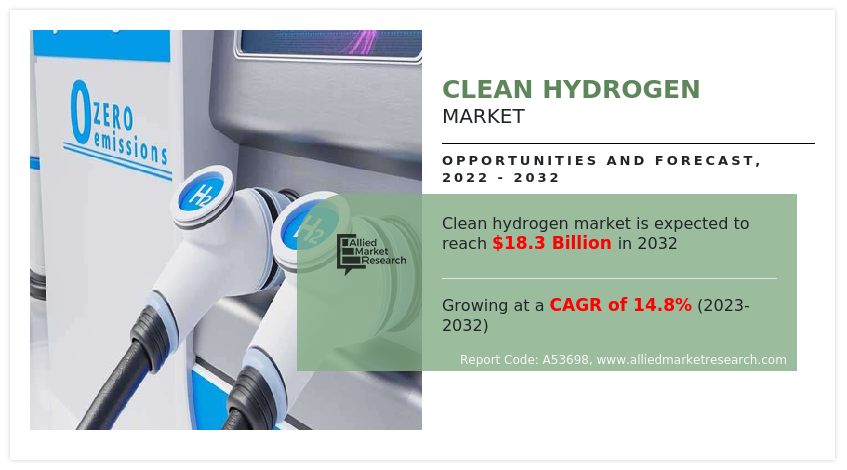
The Clean Hydrogen Market is to reach $18.3 billion by 2032, driven by decarbonization goals, hydrogen production technologies, and clean energy investments.
WILMINGTON, DE, UNITED STATES, June 25, 2026 /EINPresswire.com/ — The Clean Hydrogen Market is emerging as one of the most important pillars of the global energy transition, offering a promising pathway toward reducing greenhouse gas emissions and achieving long-term climate goals. As governments, industries, and energy companies intensify efforts to decarbonize economies, clean hydrogen is gaining significant attention as a versatile energy carrier capable of supporting sectors that are difficult to electrify through conventional renewable energy solutions.
According to industry estimates, the Clean Hydrogen Market size was valued at $3.8 billion in 2022 and is projected to reach $18.3 billion by 2032, registering a CAGR of 14.8% from 2023 to 2032. This impressive growth trajectory reflects increasing investments in hydrogen infrastructure, renewable energy integration, carbon capture technologies, and next-generation fuel solutions.
Download PDF Brochure: https://www.alliedmarketresearch.com/request-sample/A53698
Unlike conventional hydrogen production methods that generate substantial carbon emissions, clean hydrogen focuses on low-carbon or zero-carbon production pathways. The market includes blue hydrogen produced through carbon capture and storage technologies and green hydrogen generated using renewable electricity through electrolysis.
As countries pursue net-zero commitments and energy security objectives, the Clean Hydrogen Market is expected to become a critical component of future energy systems, transportation networks, industrial operations, and power generation infrastructure.
Clean Hydrogen Market Overview
The Clean Hydrogen Market represents a rapidly developing segment within the global energy industry. Hydrogen has long been used in industrial applications such as refining, chemical manufacturing, and fertilizer production. However, technological advancements and growing environmental concerns are expanding hydrogen’s role far beyond traditional applications.
Clean hydrogen offers several advantages. It can store renewable energy, serve as a transportation fuel, replace fossil fuels in industrial processes, and support grid stability through long-duration energy storage. These capabilities position hydrogen as an essential element of future low-carbon economies.
Growing concerns about climate change, stricter emissions regulations, and increasing renewable energy deployment are encouraging investments in hydrogen production facilities worldwide. Governments across North America, Europe, Asia-Pacific, and the Middle East have introduced hydrogen roadmaps and funding programs aimed at accelerating commercialization.
The Clean Hydrogen Market is benefiting from a combination of technological innovation, supportive policy frameworks, declining renewable energy costs, and growing corporate commitments to sustainability.
Market Dynamics
The evolution of the Clean Hydrogen Market is influenced by a combination of economic, environmental, technological, and regulatory factors. Rising global commitments toward carbon neutrality are creating strong momentum for hydrogen adoption across multiple sectors.
Energy-intensive industries such as steel, chemicals, cement, and refining are actively exploring clean hydrogen solutions to reduce emissions while maintaining operational efficiency. Simultaneously, transportation sectors including heavy-duty trucking, shipping, railways, and aviation are investigating hydrogen-based fuels as alternatives to fossil fuels.
Despite strong growth prospects, challenges remain. Production costs for green hydrogen continue to be higher than conventional fossil fuel alternatives. Infrastructure limitations, storage complexities, and transportation costs also present barriers to large-scale adoption.
Nevertheless, ongoing investments in research and development, government incentives, and strategic partnerships between energy companies and technology providers are expected to address many of these challenges over the coming decade.
Hydrogen and the Growing Role of Alternative Energy Systems
Hydrogen is increasingly viewed as a strategic energy carrier capable of complementing renewable energy sources such as solar and wind power. Unlike electricity, hydrogen can be stored for extended periods and transported across long distances, making it suitable for seasonal energy storage and international energy trade.
The growing use of hydrogen supports energy diversification strategies and reduces dependence on traditional fossil fuel resources. Countries with abundant renewable energy resources are investing heavily in hydrogen production hubs to capitalize on future export opportunities.
Hydrogen also offers flexibility across multiple applications, including electricity generation, industrial feedstock, transportation fuels, and energy storage systems. This versatility is contributing significantly to the expansion of the Clean Hydrogen Market.
As technology advances and production costs decline, hydrogen is expected to play a central role in supporting resilient and sustainable energy systems worldwide.
Blue Hydrogen Market and Low Carbon Hydrogen Market Development
The blue hydrogen market currently represents a significant portion of clean hydrogen production. Blue hydrogen is typically produced from natural gas through steam methane reforming combined with carbon capture, utilization, and storage technologies.
One of the major advantages of blue hydrogen is its relatively lower production cost compared to green hydrogen. Existing natural gas infrastructure and established industrial processes facilitate faster deployment and scalability.
The low carbon hydrogen market is expanding rapidly as governments implement carbon reduction targets and industries seek practical decarbonization pathways. Blue hydrogen serves as a transitional solution that enables emissions reductions while supporting the development of broader hydrogen infrastructure.
Although carbon capture technologies continue improving, market participants must address challenges related to carbon storage capacity, regulatory compliance, and public acceptance. Nevertheless, blue hydrogen remains a critical component of the evolving Clean Hydrogen Market.
Pink Hydrogen Market and Emerging Nuclear-Powered Production
The pink hydrogen market is gaining attention as countries explore diverse hydrogen production methods. Pink hydrogen is generated using electricity produced from nuclear energy, providing a low-carbon alternative to conventional hydrogen production pathways.
Nuclear-powered hydrogen production offers several benefits, including consistent electricity generation and reduced dependence on weather conditions that affect renewable energy sources. Countries with significant nuclear power infrastructure are evaluating pink hydrogen as part of broader energy transition strategies.
The market remains relatively small compared to blue and green hydrogen segments; however, ongoing innovation and growing policy support could accelerate adoption. Nuclear-powered electrolysis facilities may play an increasingly important role in supporting future hydrogen demand.
As governments seek multiple pathways toward decarbonization, the pink hydrogen market is expected to contribute to diversification within the global Clean Hydrogen Market.
Hydrogen Production and Chemical Hydrogen Generation Market
Hydrogen production technologies are at the core of market expansion. The growing chemical hydrogen generation market reflects increasing demand from industries seeking sustainable feedstocks and cleaner production methods.
Traditional hydrogen production relies heavily on fossil fuels, particularly natural gas. However, clean hydrogen technologies are transforming production processes through carbon capture systems and renewable-powered electrolysis.
Chemical industries utilize hydrogen extensively in ammonia production, refining operations, methanol manufacturing, and various industrial processes. The shift toward low-carbon production methods is driving investment in advanced hydrogen generation facilities.
Governments and private-sector organizations are funding pilot projects, demonstration facilities, and commercial-scale plants to accelerate technology deployment. These developments are expected to significantly strengthen the Clean Hydrogen Market during the forecast period.
Procure This Report (350 Pages PDF with Insights, Charts, Tables, and Figures): https://www.alliedmarketresearch.com/clean-hydrogen-market/purchase-options
Chemical Hydrogen Market and High Purity Hydrogen Market Opportunities
The chemical hydrogen market continues to represent one of the largest end-use sectors for hydrogen worldwide. Chemical manufacturers require reliable hydrogen supplies for numerous industrial processes, creating sustained demand for clean hydrogen alternatives.
Simultaneously, the high purity hydrogen market is expanding as advanced applications require exceptionally pure hydrogen. Industries including electronics manufacturing, semiconductor production, fuel cell development, and specialized chemical processing depend on high-quality hydrogen supplies.
Technological advancements are improving purification processes, reducing costs, and enhancing production efficiency. The expansion of fuel cell technologies and hydrogen-powered mobility solutions is further supporting demand for high purity hydrogen.
As industrial decarbonization efforts intensify, both markets are expected to generate substantial growth opportunities for clean hydrogen producers and technology providers.
Liquid Hydrogen Market and Electrolysis Liquid Hydrogen Market
The liquid hydrogen market is becoming increasingly important as hydrogen transportation and storage requirements expand. Liquefaction enables hydrogen to be stored and transported more efficiently over long distances, supporting international trade and large-scale energy applications.
The electrolysis liquid hydrogen market is benefiting from growing investments in renewable-powered hydrogen production. Electrolysis uses electricity to split water into hydrogen and oxygen, creating a pathway for zero-carbon hydrogen generation when powered by renewable energy.
Advancements in electrolyzer technologies, including alkaline electrolyzers, proton exchange membrane systems, and solid oxide electrolyzers, are improving efficiency and reducing production costs.
As renewable energy capacity continues expanding globally, electrolysis-based hydrogen production is expected to become increasingly competitive, strengthening long-term growth prospects for the Clean Hydrogen Market.
Hydrogen Technology Solution Market and Hydrogen Trends
The hydrogen technology solution market is experiencing rapid innovation as companies develop advanced production, storage, transportation, and utilization technologies. Digitalization, automation, and artificial intelligence are improving operational efficiency across the hydrogen value chain.
Several hydrogen trends are shaping industry development. These include increasing investments in hydrogen hubs, growing collaboration between governments and private companies, expanding fuel cell adoption, and the emergence of hydrogen trading corridors.
Energy companies are actively pursuing integrated hydrogen ecosystems that combine renewable power generation, hydrogen production, storage infrastructure, and end-use applications. Such initiatives are expected to accelerate commercialization and reduce overall project costs.
The development of hydrogen technology solutions will remain a crucial factor influencing future competitiveness and scalability within the Clean Hydrogen Market.
Segment Analysis
The Clean Hydrogen Market is segmented by type, production method, application, and geography.
By type, blue hydrogen currently accounts for a substantial market share due to its lower production costs and compatibility with existing energy infrastructure. However, green hydrogen is expected to record the fastest growth rate as renewable energy deployment expands and electrolyzer costs decline.
By production method, carbon capture technologies maintain a strong market position because they provide a cost-effective route toward lower-carbon hydrogen production. Meanwhile, electrolysis technologies are rapidly gaining traction due to increasing availability of renewable electricity.
By application, industrial use remains the dominant segment. Hydrogen is widely utilized in refining, metallurgy, chemicals, food processing, and manufacturing operations. Transportation is emerging as another high-growth segment as fuel-cell vehicles and hydrogen-powered mobility solutions gain commercial momentum.
Regional Analysis
North America currently represents one of the leading regions within the Clean Hydrogen Market. Significant investments in hydrogen hubs, supportive policy initiatives, and large-scale infrastructure projects are strengthening regional market development.
Europe remains a global leader in hydrogen policy implementation. The region’s aggressive climate targets and renewable energy investments continue driving demand for clean hydrogen technologies and infrastructure.
Asia-Pacific is expected to witness particularly strong growth throughout the forecast period. Countries such as China, Japan, South Korea, India, and Australia are investing heavily in hydrogen production, fuel cell deployment, and export-oriented hydrogen supply chains.
China remains both a major producer and consumer of hydrogen, while Japan and South Korea continue advancing ambitious hydrogen economy strategies. These developments position Asia-Pacific as a major growth engine for the Clean Hydrogen Market.
Competitive Landscape
Competition within the Clean Hydrogen Market is intensifying as energy companies, industrial manufacturers, technology providers, and infrastructure developers pursue emerging opportunities.
Leading market participants include Saudi Aramco, Sinopec, Linde plc, Exxon Mobil Corporation, Air Products and Chemicals, Plug Power, FuelCell Energy, Iberdrola, Orsted, and Enel Green Power.
These organizations are investing heavily in research and development, pilot projects, production facilities, and strategic partnerships. Collaborative ventures between energy producers, utilities, industrial users, and technology companies are becoming increasingly common.
Market leaders are focused on improving production efficiency, reducing costs, scaling infrastructure, and expanding global hydrogen supply networks.
Investment Analysis and Regulatory Landscape
Investment activity across the Clean Hydrogen Market has reached unprecedented levels. Governments worldwide have announced multi-billion-dollar funding programs supporting hydrogen research, infrastructure development, and commercial deployment.
National hydrogen strategies are playing a vital role in accelerating market growth. Regulatory frameworks increasingly emphasize carbon reduction targets, renewable energy integration, and industrial decarbonization objectives.
Carbon pricing mechanisms, tax incentives, grants, and public-private partnerships are encouraging investment across the hydrogen value chain. Financial institutions are also increasing support for hydrogen projects as sustainability considerations become more prominent.
These policy and investment trends are expected to provide a strong foundation for long-term market expansion.
Future Outlook and Key Market Insights
The future outlook for the Clean Hydrogen Market remains highly positive. Rising global energy demand, accelerating decarbonization efforts, and growing investments in renewable energy infrastructure are expected to support sustained market growth.
Advancements in electrolyzer technologies, carbon capture systems, fuel cells, and hydrogen storage solutions will continue improving economic viability. As production costs decline and infrastructure expands, hydrogen is likely to become increasingly competitive across multiple sectors.
Emerging applications in heavy transportation, industrial heating, power generation, aviation, and maritime shipping are expected to create additional demand opportunities. Strategic partnerships, technology innovation, and supportive government policies will remain key drivers shaping future market development.
Get a Customized Research Report: https://www.alliedmarketresearch.com/request-for-customization/A53698
Conclusion
The Clean Hydrogen Market is positioned to become one of the most transformative sectors within the global energy industry, growing from $3.8 billion in 2022 to an estimated $18.3 billion by 2032. Rising demand for low-carbon fuels, expanding hydrogen production capabilities, and increasing commitments to net-zero emissions are creating substantial opportunities across the value chain.
The growth of the blue hydrogen market, pink hydrogen market, liquid hydrogen market, and hydrogen technology solution market demonstrates the industry’s rapid evolution. Supported by investments in electrolysis technologies, carbon capture systems, and large-scale infrastructure projects, clean hydrogen is expected to play a pivotal role in future energy systems.
As governments, industries, and investors continue prioritizing sustainability and energy security, the Clean Hydrogen Market is set to become a cornerstone of the global transition toward cleaner, more resilient, and environmentally responsible energy solutions.
Trending Reports in Energy and Power Industry:
Clean Hydrogen Market
https://www.alliedmarketresearch.com/clean-hydrogen-market-A53698
Green Hydrogen Market
https://www.alliedmarketresearch.com/green-hydrogen-market-A11310
Hydrogen Storage Market
https://www.alliedmarketresearch.com/hydrogen-storage-market-A122780
Electrolyzer Market
https://www.alliedmarketresearch.com/electrolyzer-market-A10609
Hydrogen Infrastructure Market
https://www.alliedmarketresearch.com/hydrogen-infrastructure-market-A165713
Hydrogen Fuel Cell Market
https://www.alliedmarketresearch.com/hydrogen-fuel-cell-market
Hydrogen Generation Market
https://www.alliedmarketresearch.com/hydrogen-generation-market
Hydrogen Generator Market
https://www.alliedmarketresearch.com/hydrogen-generator-market-A12538
Hydrogen Energy Storage Market
https://www.alliedmarketresearch.com/hydrogen-energy-storage-market-A10578
Renewable Energy Market
https://www.alliedmarketresearch.com/renewable-energy-market
Solar Energy Market
https://www.alliedmarketresearch.com/solar-energy-market
Wind Energy Market
https://www.alliedmarketresearch.com/wind-energy-market-A10536
Porous Electrodes for Electrolyzer Market
https://www.alliedmarketresearch.com/porous-electrodes-for-electrolyzer-market-A12539
About Us
Allied Market Research (AMR) is a full-service market research and business-consulting wing of Allied Analytics LLP based in Portland, Oregon. Allied Market Research provides global enterprises as well as medium and small businesses with unmatched quality of “Market Research Reports” and “Business Intelligence Solutions.” AMR has a targeted view to provide business insights and consulting to assist its clients to make strategic business decisions and achieve sustainable growth in their respective market domain.
Pawan Kumar, the CEO of Allied Market Research, is leading the organization toward providing high-quality data and insights. We are in professional corporate relations with various companies and this helps us in digging out market data that helps us generate accurate research data tables and confirms utmost accuracy in our market forecasting. Each and every data presented in the reports published by us is extracted through primary interviews with top officials from leading companies of domain concerned. Our secondary data procurement methodology includes deep online and offline research and discussion with knowledgeable professionals and analysts in the industry.
David Correa
Allied Market Research
+ + + + + + + + + + + + + +1 800-792-5285
email us here
Visit us on social media:
LinkedIn
Facebook
YouTube
X
Legal Disclaimer:
EIN Presswire provides this news content “as is” without warranty of any kind. We do not accept any responsibility or liability
for the accuracy, content, images, videos, licenses, completeness, legality, or reliability of the information contained in this
article. If you have any complaints or copyright issues related to this article, kindly contact the author above.

Media gallery