Governed context layer resolves semantics, state and provenance at index time — cutting the runtime token burn that breaks agentic AI unit economics at scale.
SAN FRANCISCO, CA, UNITED STATES, September 7, 2026 /EINPresswire.com/ — Gartner’s forecast for agentic AI is blunt: more than 40% of agentic AI projects will be cancelled by the end of 2027. The reasons the firm gives are escalating costs, unclear business value, and inadequate risk controls.
For anyone who has sat in the room while an AI pilot quietly runs out of runway, none of that is surprising. What is more interesting is the diagnosis of the underlying mechanism — because it points somewhere most enterprises aren’t looking.
The failures are not primarily failures of the models or the systems. They are failures of context. When an AI application is handed information that is incomplete, poorly organised, or simply wrong, its performance degrades, its behaviour becomes unreliable, and tasks fail outright. The model was never the constraint.
Voicing AI today announced the general availability of Knowledge Mesh, an enterprise knowledge layer built specifically for this problem — now in production across financial services and telecommunications deployments.
Unearthing the deployment failures.
Multiple research treat the context layer as an emerging category in its own right. AI context platforms — software that constructs, governs, and delivers organised knowledge to AI agents — represent a market the firm sizes at roughly $28 billion in 2026, growing toward $78 billion by 2030. The market is evolving out of early retrieval infrastructure into something more demanding: governed semantic knowledge, delivered to agents at runtime, reached through open protocols.
Three shifts sit underneath that. Context is becoming a managed enterprise capability rather than a per-project scramble. Semantic assets that used to be built and thrown away for each initiative are now treated as reusable infrastructure. And governance is moving from a document-level concern — who can open this file — to a retrieval-time control that decides what an agent is permitted to see and cite in the moment it answers.
Gartner’s own projection puts a number on the payoff: organisations that prioritise semantics in their AI-ready data can expect to improve agentic AI accuracy by up to 80% and reduce costs by up to 60% by 2027. Note that accuracy and cost appear in the same sentence. That is not a coincidence, and it is the part most enterprises underestimate.
Why context gets harder — not easier — as you scale.
A single AI agent handling a single use case is a manageable problem. You can hand-build its knowledge base, hard-code its rules, and get a demo that impresses everyone.
The trouble starts at the second use case, and compounds from there.
Every new agent needs context. If each team builds its own retrieval pipeline and its own version of what a “customer” or a “policy” or an “eligible account” means, the enterprise ends up with a dozen agents that quietly disagree with each other. Rebuilding these assets for every agent slows delivery and duplicates effort that should have been done once, centrally.
It gets sharper with multi-agent systems. When several agents collaborate on a task, they need consistent shared context — and permission-aware retrieval stops being a refinement to add later. In today’s landscape it is a prerequisite for deployment.
That word matters. Not a feature. Not a roadmap item. A prerequisite.
The part that kills budgets: what a complex question actually costs.
Here is where the accuracy problem and the cost problem turn out to be the same problem.
When an agent is pointed at disconnected enterprise data, it has to do the work of connecting it — at inference time, on every single request. It reasons its way through relationships that nobody resolved in advance. It re-derives permissions. It re-figures-out which of the four things it retrieved actually relate to each other. And every step of that reasoning is tokens.
Now consider a realistic enterprise question rather than a demo one. A customer calls a bank and asks something with three intents braided together: whether a payment posted, whether that affects a fee they were charged, and what happens to their standing if they close the account this month. Three intents, three different knowledge domains, one account context that has to hold across all of it.
An agent without a context layer handles that by fanning out — pulling broadly, reasoning across everything it pulled, and burning tokens on work that has nothing to do with answering the question. Multiply by call volume. Multiply again by the number of use cases in production. The unit economics that looked fine in the pilot stop working somewhere between the first and the tenth deployment.
And the anxiety is real: 61% of IT leaders surveyed expressed concern that AI agent deployments could exceed their budgeted costs.
“Everyone benchmarks the model. Almost nobody benchmarks what they’re handing the model,” said Abhi Kumar, Co-founder of Voicing AI. “That’s why these projects die in month nine instead of month two. The pilot works, the pricing looks fine, and then you scale to five use cases and discover you’ve been paying the model to do work your architecture should have done once, at index time. It’s not a model cost problem. It’s an architecture cost problem wearing a model cost costume.”
There is a related trap that we are witnessing and the industry has been slow to absorb. Very large context windows look like a solution — just give the model everything. In practice the first few thousand tokens produce good results and quality falls off after that, while cost and latency climb the whole way. Bigger is not better. It is more expensive and, past a point, worse.
Four ways context fails:
From our experience, there are few clear failures and they are worth stating plainly because they are recognisable to anyone who has watched an agent go wrong in production.
Context poisoning. A hallucination or error makes it into the context, then gets referenced again and again, and the agent builds a strategy on top of something that was never true. Recovery is slow and difficult.
Context confusion. Too much information — especially too many tools with overlapping descriptions — overwhelms the model. It produces lower-quality output and reaches for the wrong tool.
Context rot. Over a long-running task, accumulated irrelevant and degraded input causes output quality to decline steadily until the agent is generating repetitive or fabricated responses.
Context clash. Contradictory information inside the context — often an early wrong attempt that never got cleared out — derails the reasoning entirely. Agents that assemble context from many sources are especially exposed.
Every one of these gets worse the longer an interaction runs and the more sources feed it. Which is to say: they get worse precisely as you move from demo to production.
What Knowledge Mesh does about it?
Knowledge Mesh is built as the governed layer between enterprise knowledge and every AI consumer that draws on it — voice agents, chat bots, agent-assist desktops, operator consoles.
The core architectural decision is where the expensive work happens. Rather than making an agent figure things out at request time, Knowledge Mesh resolves the hard parts when content is first brought in: hierarchies are flattened, entity aliases are resolved, validity windows are stamped, and access permissions are attached to the content itself. By the time a question arrives, the answer path is a single filtered lookup rather than a reasoning exercise.
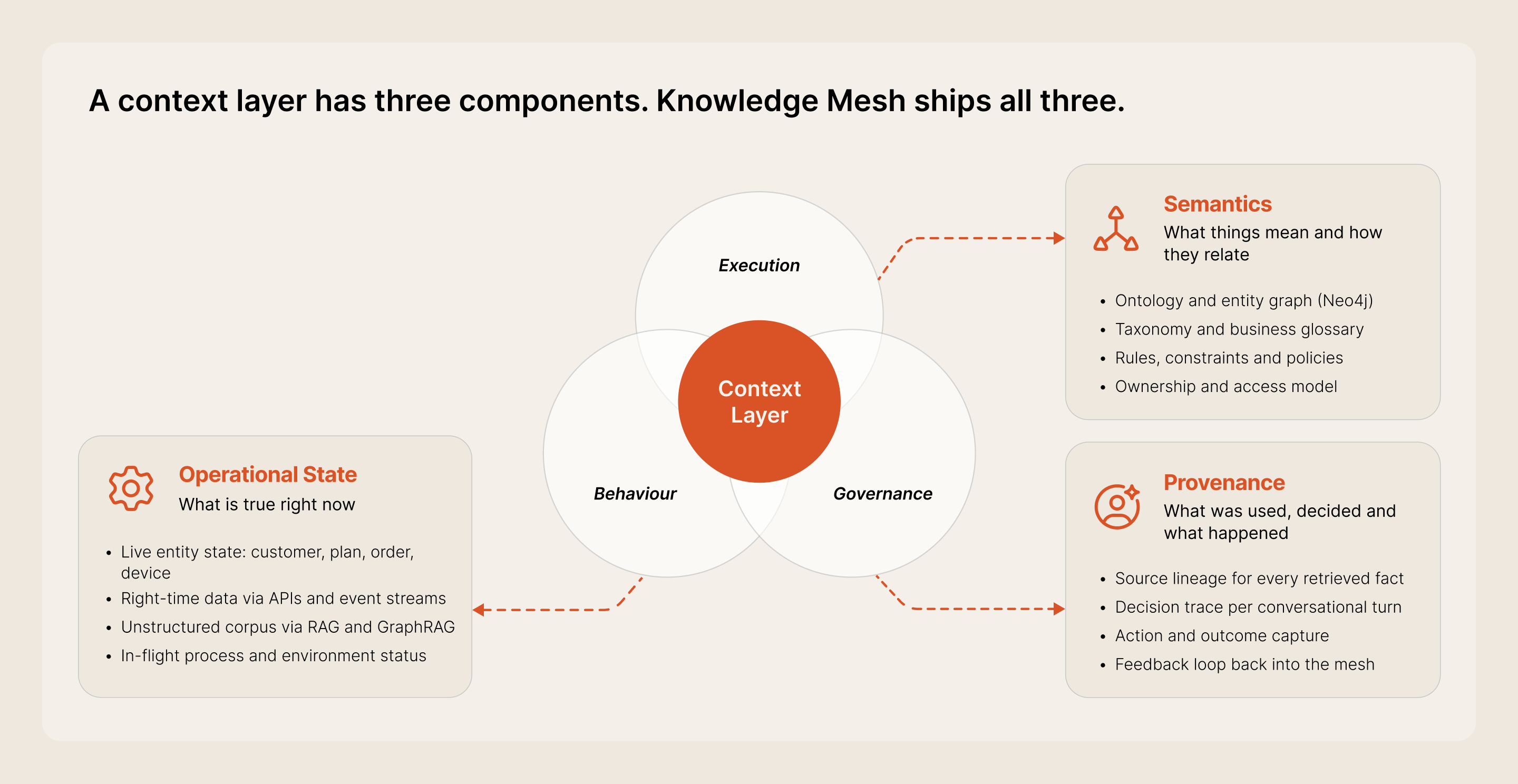
That maps directly onto the three components we identify as necessary in a context layer:
Semantics — information organised by meaning rather than keyword match, so an agent retrieves what is relevant rather than what is merely similar. When a question concerns a specific account, Knowledge Mesh resolves that account’s record first and derives the search constraints from it, converting a fuzzy similarity problem into a narrow, constrained lookup.
Operational state — the situational awareness an agent needs about a specific customer, product, or process right now. Knowledge Mesh pulls continuously from source systems on a cursor, reads only and never writes back, and surfaces a stalled source as a visible error rather than silently serving stale information.
Provenance — traceability from answer back to source. Every claim is tied to a document a supervisor can open. Every retrieval is recorded with who asked, in what role, and what came back, in a log that cannot be edited or deleted by any application path.
The system also refuses to guess. Before composing an answer, it checks whether what it retrieved actually supports one; if not, the response stops rather than continuing into invention. Citations are verified as real by construction rather than by spot-check.
On the four failure modes: poisoning is constrained because the system will not synthesise beyond retrieved evidence. Confusion is constrained because a narrow, permission-scoped retrieval reaches the model instead of everything vaguely relevant. Rot is constrained because expired content is filtered by date at every request and superseded document fragments are actively removed rather than left in the index. Clash is constrained because one retrieval engine serves every consumer, so two agents cannot disagree about what a permission check means or which version of a policy is current.
“The reason cost and accuracy move together is that they have the same root cause,” Kumar said. “Filtering late is both slower and less accurate than filtering early. Reasoning at runtime is both more expensive and more error-prone than resolving at index time. Once you see that, the architecture stops being a trade-off discussion. You’re not choosing between cheap and correct. You’re choosing between doing the work once or doing it on every request forever.”
The compatibility problem — and why native matters
There is one observation in our deployments that deserves more attention than it usually gets.
A context layer is designed to serve any AI agent. But in practice, the benefit accrues mainly to agents that were built or are deeply customisable. Off-the-shelf vendor agents generally aren’t architected to draw on an external context layer at all, unless they happen to permit that kind of integration or behavioural customisation.
Which means a great many enterprises are about to discover an uncomfortable thing: they can build an excellent context layer and their existing agents won’t be able to use it properly.
This is where Voicing AI’s position differs structurally. Voicing AI’s voice agents were not adapted to work with Knowledge Mesh — they were built against it. Retrieval, permission scoping, evidence gating, and citation handling are how the agents natively operate, not an integration layered on afterward. The agent and the context layer share one retrieval engine and one permission model, which is why an operator testing something in the console sees exactly what a live agent receives.
Knowledge Mesh is also reachable over the Model Context Protocol, which analyst firms identify as becoming a core architectural requirement rather than a nice-to-have — so enterprises running their own agents alongside Voicing AI’s can point them at the same governed source.
“Most of this industry is selling you a layer and hoping your agents can talk to it,” said Kumar. “We built both sides of that conversation. That’s not a marketing distinction — it’s the difference between a context layer that improves your agents and one that sits there being architecturally correct while nothing can reach it.”
Knowledge Mesh is available now as part of the Voicing AI platform.
About Voicing AI:
Voicing AI is an enterprise agentic voice AI platform built for Fortune 500 contact centers operating in regulated industries — banking and financial services, insurance, healthcare, aviation, and telecom. At the core of the platform is Knowledge Mesh, Voicing AI’s proprietary agentic knowledge layer, which gives every voice agent live, contextual access to the right information at the right moment in a conversation, rather than relying on static scripts or brittle retrieval. Combined with real-time translation that preserves a speaker’s own voice and identity across languages, and a growing library of specialist AI agents that plan, build, test, debug, and continuously improve voice agents in production, Voicing AI is built around a simple premise: a voice agent’s job doesn’t end at launch. The company partners with leading global BPOs and systems integrators to deploy and scale voice AI for some of the world’s largest enterprises.
Media Relations
Voicing AI
email us here
Visit us on social media:
LinkedIn
Legal Disclaimer:
EIN Presswire provides this news content “as is” without warranty of any kind. We do not accept any responsibility or liability
for the accuracy, content, images, videos, licenses, completeness, legality, or reliability of the information contained in this
article. If you have any complaints or copyright issues related to this article, kindly contact the author above.

Media gallery